 infantis
Maternal, newborn and child health
Explore how heat, air quality and other environmental conditions may affect health information, family guidance, follow-up and programme planning.
Heat, air quality, rainfall and other environmental conditions increasingly affect health. Yet the information needed to understand and respond to these risks is often separated from the health programmes, workers and communities that could use it.
Infantis is developing climate-health capabilities that connect environmental signals with relevant health contexts, helping families, community health workers, researchers and institutions move from fragmented data toward more informed action.

Weather forecasts, environmental monitoring and health information are often maintained in different systems. Even where reliable data exists, it may not reach the people managing health risks in a form that is timely, local and relevant to their responsibilities.
Health programmes need more than another climate dashboard. They need practical ways to connect environmental conditions with populations, locations, health priorities and existing programme workflows.
CHIP-EC is the climate-health intelligence engine being developed by Infantis. It is designed to bring selected environmental and health information into one configurable technology layer.
Depending on the implementation, CHIP-EC capabilities may be delivered through Infantis platforms, programme dashboards, data services or integrations with other digital systems.
The technology is being designed to support different populations and health priorities, with maternal, newborn and child health providing an important early pathway for development and learning.
Discuss a Pilot or Research Collaboration →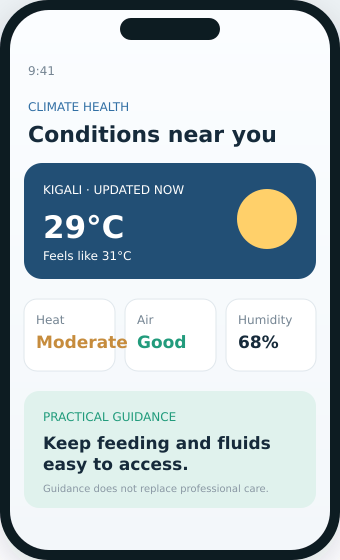
Bring together selected information such as temperature, heat conditions, air quality, humidity, rainfall and other locally relevant environmental indicators.
Relate environmental conditions to a defined population, location, health pathway or programme objective.
Provide role-appropriate information through family tools, community health worker workflows, institutional dashboards, reports or authorised data services.
Help programmes and research teams examine how environmental conditions, health observations, service use and programme responses interact over time.
Explore how heat, air quality and other environmental conditions may affect health information, family guidance, follow-up and programme planning.
Give community health workers and supervisors relevant environmental context when organising outreach, follow-up and community engagement.
Support locally appropriate heat information, risk communication and programme preparedness for populations with heightened vulnerability.
Connect air-quality information with communication, observation and programme-level learning where appropriate data is available.
Support the responsible combination of environmental and programme information for surveillance, research and preparedness.
Use selected capabilities as digital infrastructure for studies examining climate exposure, health behaviour, service delivery, adaptation or related questions.
Plain-language, locally relevant environmental information delivered within an appropriate health context.
Practical information that can support outreach, communication and follow-up within participating programmes.
Dashboards, configurable indicators and programme views that help institutions monitor changing conditions and coordinate responses.
Structured environmental and health-data pathways that can support approved research designs, implementation studies and evaluation.
APIs and data-exchange pathways that allow selected capabilities to complement other health, climate or public-service platforms.
Environmental inputs, health pathways, thresholds, languages and programme experiences can be adapted to the setting and intended use.
Selected capabilities can be connected to other platforms through configurable APIs, structured exports and appropriate integration pathways.
User experiences can be designed for settings where continuous connectivity cannot be assumed.
Information should communicate what a signal means, where it comes from and the limits of what can reasonably be inferred.
Health, location and environmental information must be handled according to appropriate permissions, governance arrangements and applicable legal requirements.
Capabilities should be tested for usability, relevance, implementation value and unintended consequences before broader deployment.
CHIP-EC is under development. Its capabilities will be introduced and evaluated in phases through technical development, user engagement, research and implementation partnerships.
Our learning questions include whether climate-health information reaches the right people, whether it is understood, whether it supports appropriate action and how it can strengthen existing health programmes without creating unnecessary complexity.
We distinguish between environmental information, programme intelligence and clinical judgement. CHIP-EC does not diagnose medical conditions, replace professional care or serve as an emergency warning service unless explicitly developed and validated for a defined institutional use.
Explore Our Evidence Approach →We welcome collaboration with ministries, health systems, meteorological institutions, development organisations, community programmes, universities, research teams, funders and technology partners.
Partnerships may include: